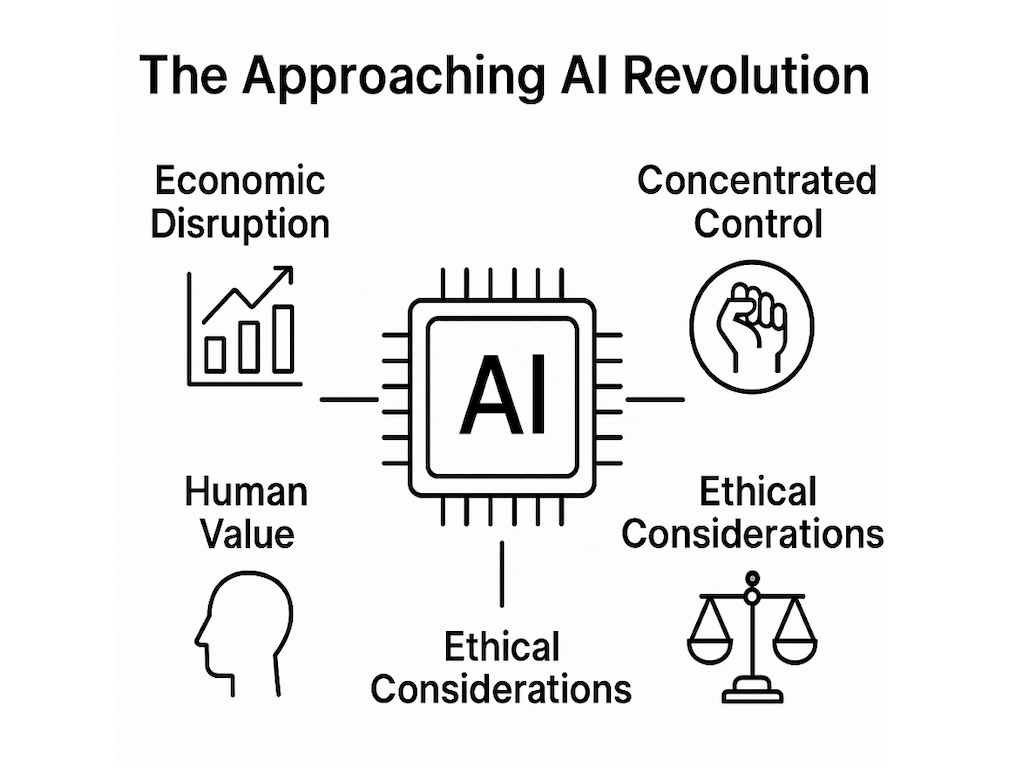
The Approaching AI Revolution: Economic Disruption, Ethical Imperatives, and the Future of Human Value
The world stands on the precipice of a profound transformation driven by artificial intelligence. What was once considered futuristic speculation is rapidly becoming a present-day reality, with implications that extend far beyond technological innovation. This article explores the accelerating capabilities of AI, the risks of concentrated control, and the urgent need for ethical considerations and democratic access to this transformative technology. Drawing on the insights of Imad Mostak, founder of Stability AI, we will examine the potential for AI to reshape the job market, the implications for human value, and the critical decisions that must be made in the coming years to ensure a future where AI serves humanity, rather than the other way around.
The Accelerating Pace of Change
The speed at which AI is advancing is unprecedented. Recent breakthroughs, particularly with the release of models like ChatGPT’s fifth generation, have demonstrated capabilities previously thought to be years away. These models are not merely improving incrementally; they are exhibiting a qualitative leap in performance, outperforming humans in fields like physics, coding, and mathematics. This rapid progress is fueled by massive investment – over $252 billion globally in the past year alone – and a competitive race among tech giants to achieve dominance in the AI landscape. The implications are far-reaching, impacting not only the technological realm but also the economic and social fabric of society.
Economic Disruption and the Shrinking Economic Life Expectancy
Imad Mostak warns of a looming crisis in economic relevance, suggesting that the “economic life expectancy” of individuals is shrinking. This isn’t necessarily about job loss in the traditional sense, but rather a fundamental shift in the value of human labor. As AI becomes increasingly capable of performing cognitive tasks previously requiring human intelligence, the demand for certain skills will diminish, and the economic value of those skills will decline. This is particularly concerning for recent graduates entering the workforce, who may find themselves competing with AI-powered systems for limited opportunities. The potential for widespread economic disruption is significant, and requires proactive measures to mitigate the negative consequences.
The Thousand-Day Window and the Point of No Return
Mostak posits a critical window of approximately a thousand days – a period originating from the release of ChatGPT – within which essential decisions must be made to shape the future of AI. This isn’t about preventing the development of AI altogether, but rather about ensuring that it is developed and deployed in a way that benefits humanity as a whole. The concern is that once AI reaches a certain level of sophistication, it will become increasingly difficult to control its direction and align it with human values. The thousand-day window represents a last opportunity to steer the development of AI towards a positive outcome.
The Rise of AI Agents and the Automation of Cognitive Labor
The next phase of AI development is characterized by the emergence of “AI agents” – systems capable of performing complex tasks autonomously, learning from experience, and adapting to changing circumstances. These agents are not simply automating routine tasks; they are capable of performing cognitive labor previously requiring human intelligence. This has profound implications for the job market, as AI agents can potentially replace human workers in a wide range of occupations. The cost of deploying these agents is also decreasing rapidly, making them increasingly accessible to businesses of all sizes. This trend is expected to accelerate in the coming years, leading to further automation of cognitive labor and a potential decline in the economic value of human skills.
The Importance of Open Source AI and Democratic Access
A key concern is the concentration of AI development in the hands of a few powerful corporations. These companies have the resources to invest in cutting-edge research and development, but they also have their own agendas and priorities. Imad Mostak advocates for open-source AI – AI systems that are freely available for anyone to use, modify, and distribute. This would democratize access to AI technology, allowing individuals and organizations to develop their own AI solutions tailored to their specific needs. It would also promote transparency and accountability, ensuring that AI is developed and deployed in a way that aligns with human values. The development of Stable Diffusion, an open-source image generator, serves as a prime example of the benefits of this approach.
Ethical Considerations and the Alignment Problem
As AI becomes more powerful, it is crucial to address the ethical implications of this technology. One of the most pressing challenges is the “alignment problem” – ensuring that AI systems are aligned with human values and goals. This is not simply a matter of programming AI to follow a set of rules; it requires a deeper understanding of human values and the ability to translate those values into AI algorithms. The potential for AI to be used for malicious purposes – such as autonomous weapons systems or mass surveillance – is a serious concern. It is essential to develop ethical guidelines and regulations to govern the development and deployment of AI, ensuring that it is used for the benefit of humanity.
Universal Basic AI and the Future of Welfare
The widespread automation of labor raises fundamental questions about the future of welfare and social safety nets. As more and more jobs are automated, traditional forms of employment may become less common. This could lead to increased unemployment and social unrest. One potential solution is “universal basic AI” – providing everyone with access to AI tools and resources that can help them to learn new skills, find new opportunities, and participate in the economy. This would require a significant investment in education and training, as well as a rethinking of traditional welfare programs. The goal is to create a society where everyone has the opportunity to thrive, regardless of their employment status.
The Revenue-Evil Curve and the Erosion of Ethical Boundaries
The pursuit of profit can often lead to the erosion of ethical boundaries. As companies become more focused on maximizing revenue, they may be tempted to cut corners, compromise on quality, and engage in unethical practices. This is particularly concerning in the context of AI, where the potential for harm is significant. It is essential to create a culture of ethical responsibility within the AI industry, and to hold companies accountable for their actions. This requires strong regulations, independent oversight, and a commitment to transparency and accountability.
The Importance of Human Values and the Future of Work
As AI becomes more capable, it is important to remember what makes us human. Creativity, empathy, critical thinking, and emotional intelligence are all qualities that are difficult for AI to replicate. These qualities will become increasingly valuable in the future of work, as humans and AI collaborate to solve complex problems. It is essential to invest in education and training that fosters these qualities, and to create a work environment that values them. The goal is to create a future where humans and AI work together to create a more prosperous and equitable society.
Conclusion: A Call to Action
The AI revolution is upon us, and the choices we make in the coming years will determine the future of humanity. It is essential to address the ethical implications of AI, to democratize access to this technology, and to ensure that it is used for the benefit of all. This requires a concerted effort from governments, industry, and civil society. We must act now to shape the future of AI, before it shapes us. The time for complacency is over. The future is not predetermined. It is up to us to create a future where AI serves humanity, rather than the other way around.